
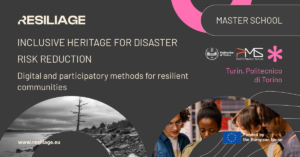
As disasters and climate-related crises intensify, communities need more than emergency plans — they need approaches that help people understand risk, act together, and recover with dignity. Developed as an output of the RESILIAGE project, this international Master Programme positions heritage (cultural, natural, tangible, intangible, and living) as a powerful driver for mitigation, adaptation, and positive change — with a strong focus on inclusivity, gender-responsive approaches, and people in situations of vulnerability.
Delivered in English and hosted in Turin (Politecnico di Torino), the programme brings together advanced research, policy, and real-world practice in disaster risk reduction and climate action.
- Type: 1st level Specialising Master’s Programme (60 ECTS)
- Institution: Politecnico di Torino (Master’s Programmes & Lifelong Learning Office; School of Master and Lifelong Learning)
- Location: Politecnico di Torino (POLITO), Castello del Valentino – UNESCO World Heritage site
- Partners: Natural History Museum of the University of Crete, University of Nimes, UNESCO
- In collaboration with: ProCultHer
- Programme Director: Prof. Rosa Tamborrino (DIST, Politecnico di Torino)
- Scientific Committee
-
- Daniela Di Bucci, Dipartimento della Protezione Civile, Consiglio dei Ministri
- Mesut Dinler, POLITO
- Gilles DUSSERRES, Université de Nîmes
- Charalambos Fassoulas, Natural History Museum, University of Crete
- Enrico Macii, POLITO
- Oscar Navarro, Université de Nimes
- Irina Pavlova, UNESCO
- Rosa Tamborrino, POLITO and RESILIAGE Coordinator
- Patrizia Vicario, Dipartimento della Protezione Civile, Consiglio dei Ministri, PROCULTHER-Net Coordinator
- Application: Apply only via Apply@Polito (no email/fax/post accepted). Available at: https://www.polito.it/en/education/specializing-master-s-programmes-and-lifelong-learning/specializing-master-s-programmes/specializing-master-s-catalogue/
- Deadline: 3 April 2026, 2:00 pm (Italian time)
- Mandatory uploads include: ID, CV, transcript/self-certification, application form + questionnaire, motivation letter (max 1 page). Optional: thesis abstract, English certificate.
- Participation fee: €4,000 participation fee + €21 enrolment fee
What you’ll gain
You’ll gain practical, interdisciplinary skills to:
• Connect heritage with DRR and climate adaptation strategies
• Apply digital methods (FAIR data, multisource approaches, mapping, APIs, VR)
• Use participatory tools (co-creation, citizen science, community archaeology, collective memory work)
• Work with inclusive, gender-sensitive, ethically grounded approaches to data and community engagement
You’ll learn from academics and practitioners — including expertise linked to UNESCO and the Italian Civil Protection ecosystem.
Who it’s for
The programme is designed for recent graduates and early-career professionals, as well as practitioners already working in areas such as heritage and culture management, disaster/crisis management, citizen engagement, environmental and landscape management, policy, communication, planning, and related fields.
The programme provides explicit attention to inclusivity, gender sensitivity, diversity and ethical data use.
Format & delivery
• Language: English
• Delivery: mainly online, with in-person lectures at Politecnico di Torino
• In-person lectures will take place between 13 and 22 July 2016, at the premises of Politecnico di Torino,, Turin, Italy
• Includes: lectures, labs, hands-on tutorials, scientific workshops, keynotes, visits (labs/companies), orientation sessions
Timeline (one-year pathway)
May 2026 – May 2027
- 18 May 2026 (remote): general introduction and presentation of the programme
- 19 May – 30 June 2026: preparatory courses on fundamentals on Heritage, Digital skills, Environmental psychology, Natural induced disasters, and anthropogenic risks
- Mid-July 2026: 10-day residential phase (dates indicated: 13–22 July, alternative 20–29 July)
- Aug 2026 – Jan 2027: distance learning (lessons/exercises)
- Jan – Apr 2027: distance tutoring + project work / internship + report
- By 30 April 2027: submission of final work/report
- By 14 May 2027: final evaluation
- May 2027: award ceremony
Contact
Specialising Master’s Programmes and Lifelong Learning Office
- Email: master.universitari@polito.it
- Politecnico di Torino, Corso Duca degli Abruzzi 24, 10129 Turin, Italy