
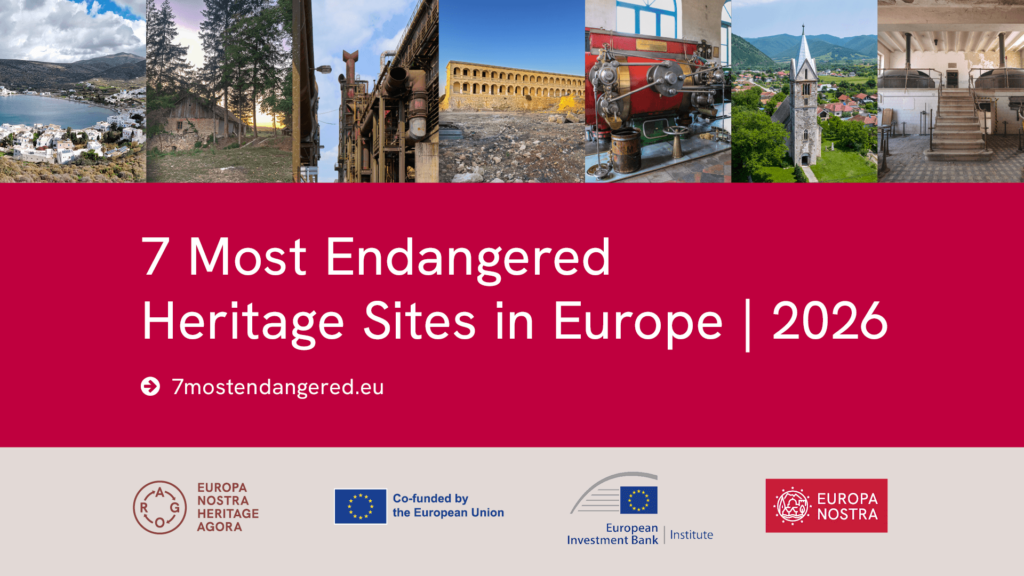
Europa Nostra, the leading European heritage civil society network, has released today the list of the 7 Most Endangered heritage sites in Europe for 2026, in the frame of its 7 Most Endangered Programme, run with the support of the European Investment Bank (EIB) Institute. Since its launch in 2013, this nomination-based programme has become a key civil society initiative dedicated to saving Europe’s heritage at risk, acting as a catalyst for mobilising expertise, halting unsuitable development, and/or ensuring public and private support, including funding, among other forms of assistance. Each case on the final list is eligible to receive an EIB Heritage Grant of €10,000 to support action towards saving it.
This is the list of the 7 Most Endangered Heritages sites in Europe* for 2026:
– Katapola Village and Ancient City of Minoa, GREECE
– Fábri Watermill, Feked, HUNGARY
– Blower Hall, Esch-sur-Alzette, LUXEMBOURG
– British Barracks at Fort Chambray, Gozo, MALTA
– Vale de Milhaços Gunpowder Factory, Seixal, PORTUGAL
– Reformed Church of Sântămăria Orlea, ROMANIA
– Weifert’s Brewery, Pančevo, SERBIA
This year’s list comprises a wide variety of heritage sites – from the remains of an ancient city in Greece to an early 20th-century monumental industrial heritage structure in Luxembourg – facing major challenges, such as unsuitable development projects, neglect or lack of funding. The 7 sites were selected on the basis of their European significance, cultural and social value, as well as the serious danger that they are facing. The level of engagement of local communities and/or the commitment of public and private stakeholders to saving these sites were considered as being of crucial added value. Another selection criterion was the potential of each of the sites to act as a driver of sustainable socioeconomic development.
The 7 sites were selected by the Board of Europa Nostra from among the fourteen cases of heritage at risk previously preselected by the Advisory Panel of the 7 Most Endangered Programme. The nominations for the 7 Most Endangered Programme 2026 were made by public and private organisations active in the heritage field, or individual members of these organisations, coming from a Member State of the Council of Europe, with the endorsement of a Europa Nostra Member or Associate Organisation.
The list of 7 Most Endangered 2026 was unveiled at an online event featuring the participation of high-level representatives from Europa Nostra, the EIB Institute and the European Commission, as well as the nominators and representatives of the listed sites.
The Vice-President of Europa Nostra, Guy Clausse, stated: “By listing the most endangered heritage sites in Europe, Europa Nostra underscores its commitment to ensuring that heritage preservation not only honours the past but actively contributes to building more sustainable, inclusive and democratic communities throughout our continent. Cultural and natural heritage must be recognised as a living force driving growth, sustainability and cohesion, and, therefore, be put at the core of European strategies, policies and budgets.”
Experts representing Europa Nostra, including experienced EIB retired agents who volunteer to support the 7 Most Endangered Programme, together with the organisations and individuals that nominated the 7 selected sites, will form dedicated European experts’ teams for each site. These teams will gather information, meet with key stakeholders, and carry out site missions to assess conditions on the ground. The findings will inform a report with recommendations for action and support the development of a tailored project for each site, to be implemented over the next two years with the support of the EIB Heritage Grant, marking the beginning of a longer-term cooperation with local stakeholders.
For more information, please click here.